

Sustainability
As a long-term asset owner, sustainability anchors how we build a resilient and forward-looking portfolio.
Geopolitical fragmentation, supply chain disruptions, and rapid Artificial Intelligence (AI) adoption have renewed the focus on energy security and affordability. These shifts are also reshaping global value chains and labour demand. Meanwhile, rising global temperatures are driving more frequent extreme weather events. Coupled with accelerating ecosystem degradation and biodiversity loss, these pressures are increasingly affecting economies, communities, and business resilience.
Against this backdrop, sustainability is not a parallel agenda. It is a key contributor to strengthening institutional and portfolio resilience.
This is why sustainability remains at the core of everything we do — from our mandate to deliver good sustainable returns over the long term, to our strategy of how we operate as an institution, shape our portfolio, and engage our portfolio companies to build sustainable businesses.
Sustainability Updates
We have refreshed our baseline climate scenario, reflecting an increase in average global temperature from 1.8oC to 2.4oC by 2100. This takes into account a more fragmented global landscape with inconsistent climate action, varying carbon pricing, and uneven technology deployment. The updated baseline provides us with a more realistic view of how climate-related risks and opportunities — including both physical and transition impacts — may affect our portfolio and future investments.
The headwinds to the global transition and shifts in the operating environment are also impacting our portfolio decarbonisation trajectory. Under current conditions, and given our portfolio exposure to hard-to-abate sectors, we are unlikely to meet our interim 2030 climate target40 which was set in 2019, when there was greater global momentum for climate action. However, we remain committed to our 2050 net zero ambition, navigating near-term volatility while staying focused on long-term outcomes.
Our climate strategy is threefold:
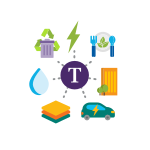
Investing for a Low-Carbon Economy
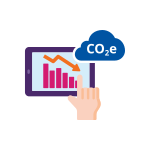
Encouraging Decarbonisation Efforts in Our Portfolio Companies
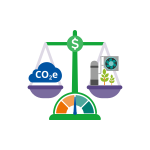
Enabling Carbon Markets Solutions
Beyond climate and nature risks, workforce disruption arising from technological advancements is accelerating. Building a resilient and future-ready workforce across our Singapore-based Temasek Portfolio Companies is increasingly critical for business continuity and sustainable long-term performance. We have stepped up our engagements with portfolio companies to anticipate skills disruption, build AI fluency, and support workforce transformation.
As an investor and owner, we expect and work with our portfolio companies to contribute towards real-world impact.
We aim to build a resilient and forward-looking portfolio — one that is able to withstand market shocks and capitalises on growth opportunities to deliver good sustainable returns over the long term on a risk-adjusted basis.
Investing to Drive Sustainable and Inclusive Growth
Sustainable Living is one of the four structural trends that guides our portfolio construction.
During the year, we invested S$5 billion in line with the Sustainable Living trend. As at 31 March 2026, our portfolio value of investments aligned with the trend was S$49 billion41.
We continued to invest in the energy transition through a systems approach by deploying capital into cleaner energy generation and storage, and infrastructure that enables electrification. As electrification, data centres, and Artificial Intelligence (AI) drive growth in power demand, we also invested in solutions that strengthen grid resilience, improve efficiency, and support a reliable, affordable, and lower-carbon energy system.
For example, we invested in Luminace, a US-based provider of decarbonisation-as-a-service solutions to commercial, industrial, and public sector customers, and a distributed generation platform with solar and storage assets; and CleanMax, an India-based renewable energy company focused on commercial and industrial customers. We also invested in NARI Technology, a China-based provider of smart grid and power automation technologies that enable large-scale integration of renewables, and US- and Singapore-based Amperesand, which develops solid-state transformer systems to improve grid efficiency and support the needs of hyperscalers and megawatt electric vehicle charging.
Our impact investments continue to deliver measurable positive outcomes for underserved communities in emerging markets, while generating sustainable long-term returns. In 2025, these investments provided essential goods and services across healthcare, financial inclusion, and climate-related areas to 57 million customers, of which 45 million were underserved, and supported 85,000 jobs.
We also advanced efforts to scale high-integrity carbon markets and nature-related investments through our carbon solutions platform, GenZero. Over the year, GenZero invested in sustainable timberland in Latin America and forged a strategic alliance with Tencent to unlock potential demand for high-integrity carbon credits.
Find out more about our other Sustainable Living investments
Emissions Associated with Our Portfolio
We have been disclosing the carbon emissions attributable to our investment portfolio as part of our annual reporting, and are tracking the progress towards our climate targets.
Total Portfolio Emissions42 encompass 79%43 of the portfolio as at 31 March 2026.
Total Portfolio Emissions remained at 21 million tonnes of carbon dioxide equivalent (tCO2e), for the financial year ended 31 March 2026.
Portfolio Weighted Average Carbon Intensity44 decreased to 83 tCO2e/S$M revenue, from 89 tCO2e/S$M revenue for the previous financial year45.
Portfolio Carbon Intensity46 decreased to 50 tCO2e/S$M portfolio value, from 57 tCO2e/S$M portfolio value for the previous financial year45.
Our Singapore-based Temasek Portfolio Companies (TPCs) contribute approximately 89% of Total Portfolio Emissions as at 31 March 2026, with Sembcorp Industries (SCI) and Singapore Airlines (SIA) accounting for the majority of it. Companies in high-emitting sectors, including power generation and aviation, continue to face systems-level constraints that impede their progress in emissions reduction. This concentration of emissions, coupled with structural limits to near-term abatement, means that progress at the portfolio level will be inherently uneven, and hence we are unlikely to meet our interim 2030 climate target.
(for year ending 31 March)
Towards Net Zero

- Emissions attributable to SCI
- Emissions attributable to SIA
- Emissions attributable to Singapore-based Temasek Portfolio Companies (ex SCI & SIA)
- Emissions attributable to Global Direct Investments
- Total Portfolio Emissions2 (Illustrative)
- Pathway for Net Portfolio Emissions (Illustrative)
- Calendar year emissions data and targets are reported in the subsequent financial year
1 tCO2e refers to tonnes of carbon dioxide equivalent, a standard unit of measurement used in greenhouse gas emissions accounting and reporting.
2 Total Portfolio Emissions reflect the absolute emissions (Scope 1 and Scope 2) associated with our investment portfolio, expressed in tCO2e. Our investment positions in private equity funds, credit, and other assets are excluded.
Find a more detailed breakdown of our portfolio metrics and targets
Engagement with Our Portfolio Companies
Sustainability continues to be a key lever for long-term value creation and strengthening the resilience of our portfolio. This is especially so for our TPCs, where our long-term ownership means we bear long-tail risks.
We work with our portfolio companies to drive progress on environmental and social issues, and advance efforts to embed sustainability across their businesses, tailored to their respective contexts.
We encourage our major portfolio companies to adopt effective climate change mitigation and adaptation measures for business resilience. Using our Climate Transition Readiness Framework, we assess each company’s maturity in addressing climate-related risks and opportunities. We set company-specific expectations according to each company’s maturity level, focusing on progress towards interim milestones and decarbonisation pathways. During the year, we engaged 19 major portfolio companies representing 88% of Total Portfolio Emissions. Fifteen of them have set targets to achieve net zero by 2050 or earlier.
We also work with select portfolio companies to drive value creation through our Environmental, Social, and Governance (ESG) Value Creation Playbook, prioritising companies that are early in their ESG journeys as well as those with clear potential to drive value creation through sustainability.
Beyond sustainability, we engaged our portfolio companies on wide-ranging issues such as governance, AI transformation, workforce resilience, and cybersecurity, to strengthen their resilience and long-term performance.
Find out more about how we engage our portfolio companies on sustainability
Through our partnerships, we aim to mobilise capital, scale solutions, and catalyse systemic change for a more resilient and sustainable future.
Over the year, we deepened partnerships across our ecosystem to catalyse real-world impact.
Accelerating Aviation Decarbonisation
Addressing aviation’s decarbonisation challenge requires coordinated and sustained action across the ecosystem.
We continued to work with partners to accelerate the adoption and scaling of Sustainable Aviation Fuels (SAF). In February 2026, we signed a Memorandum of Understanding alongside public and private sector organisations to participate in the first trial for centralised procurement of voluntary SAF in Singapore. The initiative will support the development of a scalable and integrated national-level SAF ecosystem.
Through Xora Innovation, our deep-tech early-stage investment platform, we supported Aether Fuels, a climate technology company, in its partnership with Aster47 to develop Southeast Asia’s first next-generation commercial-scale SAF plant.
Mobilising Capital Through Our Platforms
Climate financing continues to be critical to scaling decarbonisation and supporting the bankability and development of sustainable projects in Asia.
During the year, alongside private, public, and philanthropic institutions, we contributed both commercial and concessional capital to the Green Investments Partnership (GIP), a blended finance partnership under Singapore’s Financing Asia’s Transition Partnership (FAST-P) initiative. Managed by Pentagreen Capital, our joint venture with HSBC, GIP supports capital-constrained sustainable infrastructure opportunities in Southeast Asia and South Asia, helping to crowd in capital and accelerate the region’s transition.
Clifford Capital, a platform we established alongside other financial institutions, issued its sixth and seventh public infrastructure asset-backed securities (IABS) in 2025, totalling US$1.23 billion. This was followed by its eighth issuance in April 2026, which was its largest offering to date at US$733 million. This brought the cumulative IABS issuance to US$4.7 billion across public and private markets. Clifford Capital has also been appointed as the manager for the Energy Transition Acceleration Finance partnership under FAST-P, which is focused on replacing or displacing carbon-based power generation.
Advocating Sustainability Through Our Convening Role
Ecosperity is Temasek’s thought leadership and convening platform that advances dialogue, partnerships, and action for sustainability.
Its annual flagship event, Ecosperity Week 2026, was themed “Asia’s Race Towards 2030: Powered by Innovation, Driven with Intent”, and focused on breakthrough technologies and innovative business models. Across the main plenaries and more than 60 partner events, the week-long event convened over 9,000 participants in person and online from the business, investment, government, and philanthropy sectors globally. Discussions explored opportunities across the areas of Artificial Intelligence, sustainable data centres, the electrification value chain, and climate adaptation and resilience.
Ecosperity continued to convene diverse stakeholders through the year to align priorities, foster partnerships, and translate insights into action. This included our Ecosperity Conversation series and contributions to forums such as the United Nations Framework Convention on Climate Change Conference of the Parties and London Climate Action Week.
Find out more about our efforts to accelerate sustainability across our ecosystem
Sustainability extends beyond the way we invest, to how we shape our operations and culture.
Managing Environmental Impact Arising from Our Operations
For the year ended 31 March 2026, emissions from our operations were 13,222 tCO2e, a decrease from 19,731 tCO2e last year. This was attributable to a decrease in reported emissions from business travel despite comparable travel volumes, following updated air travel emissions factors48.
We continue to prioritise emissions avoidance and reduction efforts where we have direct control, such as by applying a carbon charge for business travel to promote disciplined travel practices.
To compensate for residual emissions from our operations, we purchased high-quality carbon credits from Climate Impact X and GenZero, prioritising credits that are verified by recognised global standards and are of more recent vintages.
We also purchased Sustainable Aviation Fuel (SAF) certificates to compensate for a portion of our business travel-related emissions. This is in line with our broader efforts to strengthen demand visibility and accelerate the scaling of SAF for aviation decarbonisation.
Read more about how we are reducing the overall environmental impact arising from our operations
Fostering a Diverse, Inclusive, and Fair Workplace
Diversity, inclusion, and fairness are key to fostering a work environment that recognises talent and respects differences across a wide range of dimensions. We continue to build a diverse and inclusive culture rooted in the principle of meritocracy.
We are intentional in creating opportunities for every employee to contribute to their fullest potential, and to feel valued and respected regardless of their background. These include providing access to resources, mentorship, and career development opportunities — alongside a comprehensive range of benefits to support evolving needs across different life stages.
Our Inclusivity@Temasek initiatives continue to strengthen our inclusivity practices and reinforce our culture of belonging. One such initiative, Temasek Women’s Network, supports and inspires our employees in their career and personal journeys. Highlights during the year included our annual keynote event, Women Rising, that provided leadership perspectives on organisational transformation; our International Women’s Day celebrations that brought peers from our portfolio companies together; and learning sessions on topics ranging from menopause to caregiving and neurodiversity.
Over the year, more than 900 of our employees participated in sustainability-focused activities globally. These included hands-on activities to deepen environmental awareness and encourage more sustainable mindsets and choices beyond the workplace, as well as visits to learn about Singapore’s sustainability efforts.
Find out more about how we support our employees to build a resilient workforce
Find out more about how we embed sustainability across the way we operate